
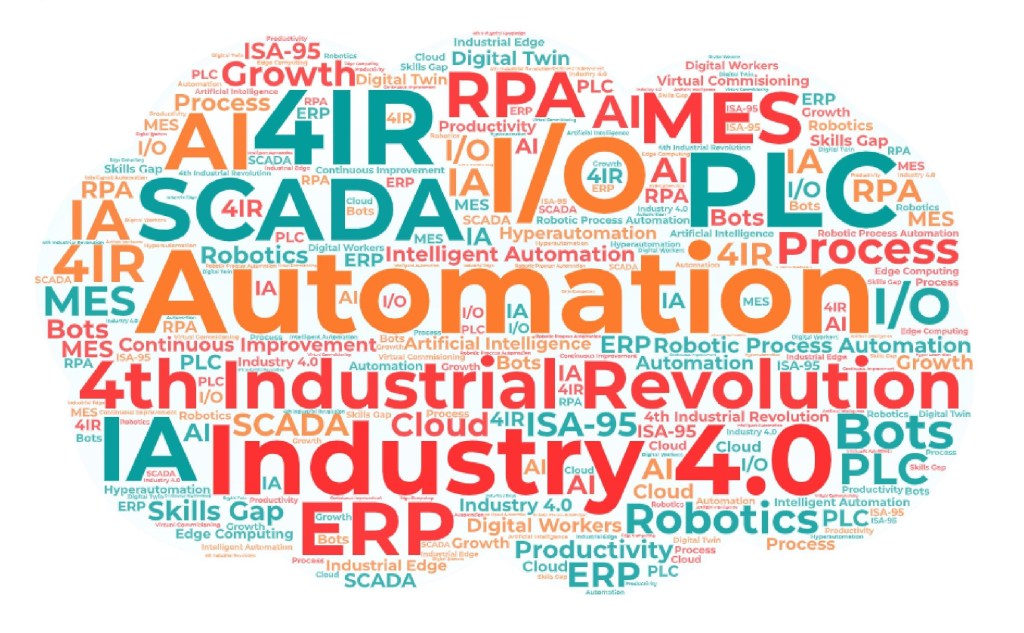
Welcome to the very first S3QUENT blog post, where the aim is to cut to the chase and clarify some of the more common Buzzwords, Acronyms, Jargon and how they are spun in the field of Automation. Our aim at S3QUENT is to disrupt the status quo of the Automation sector, to offer a refreshing take on the implementation of Automation, and to close the gaps between the front runners boosting the UK Manufacturing sector.
To start, what is Automation? In simple terms Automation is the alternative to Manned operation of processes, such as turning a length of raw material into a component or part. This process may have once been performed completely manually, via a Lathe or other Machine Tool but with the advent of Computer Numeric Control (CNC), this example process has now been Automated. Or at least, to a certain extent, it has been.
The reality is a certain number of steps have been completed by the CNC machine tool, thus part of the overall process of producing a finished part have now been Automated, but a complete an thorough examination of all the process steps used end-to-end in manufacturing can reveal that much remains in the hands of manual operation. Cutting and measuring of raw material, loading and handling of raw material into machine tools, unloading and handling of finished or part-finished parts, quality inspection, packaging and storage to name but a few.
Automation then, can be seen as the inverse of Manned operation, and in-fact ‘Automation Level’ is defined as being inversely corelated with ‘Manning Level’. Manning Level being the proportion of time a worker spends at a particular station. For example; whereas once one machinist worked one machine, a machinist may now be running two or more CNC machines. The manning level of a manual machine being equal to 1, and the manning level of each of the two CNC machines is equal to 0.5, thus the automation level of each CNC machine is equal to 0.5.
The process of Automation is fundamentally about the management of change, the change from Manned operation to Automated operation, and here in lays the difficulty for businesses both large and small, change is a difficult thing to achieve. Especially when surrounded by the noise of Buzzwords, Jargon and the Spin surrounding sales pitches eager to capitalize upon the latest and greatest thing.
Continual Improvement (CI) or Continuous Improvement Process (CIP) is a business change management strategy, linked with Section 10 of the ISO 9001 standard, CI is often used as a driver to embrace Automation and increasing the Automation Level within business processes.
The Fourth Industrial Revolution, 4IR, or Industry 4.0 are particularly prominent terms used within the field of automation. Building on the concept of Industry 1.0 (Mechanization), Industry 2.0 (Electrification) and Industry 3.0 (Automation). Industry 4.0 (Cyber-physical systems) represent the convergence of Operational Technology (OT) with Information Technology (IT).
Industrial Internet of Things (IIoT) or Internet of Things (IoT) builds on the Industry 4.0 concept of the Cyber-physical system, representing the networking of Operational Technology (OT) and Information Technology (IT). A novel concept, but with limitations. A manager may not be concerned with the current status of a sensor on the end of a conveyor, but more interested in what changes to the sensors status represents, such as how many parts have been detected over a given amount of time.
International Society of Automation ANSI/ISA-95, or ISA-95 is an international standard developed to provide consistent terminology for the automated interface between enterprise (IT) and control systems (OT). While many believe that Industry 4.0 would disrupt this standard, it has withstood the test of time and adopted into the IEC 62264 standard.
Enterprise Resource Planning (ERP) represents Layer 4 of the ISA-95 model, wherein upper management or director level Information Technology (IT) used to define the business-related activities needed to manage a manufacturing operation as part of long-term business decision making.
Manufacturing Execution System (MES) represents Layer 3 of the ISA-95 model, defined as the Manufacturing Operations Management (MOM) level Information Technology (IT) used for defining the activities of workflow to produce the desired end products as part of medium-term business decision making.
Supervisory Control And Data Acquisition (SCADA) or Human Machine Interface (HMI) represents Layer 2 of the ISA-95 model, defined as the Operational Technology (OT) and Information Technology (IT) convergence level, and defines the activities of monitoring and controlling the physical processes by the Layer 1 Programmable Logic Control (PLC) level. Such as the Human Machine Interface used short-term business decision making.
Programmable Logic Control (PLC) represents Layer 1 of the ISA-95 model, defined as the Operational Technology (OT) level or Machine decision making layer controlling processes carried out at the Layer 0 Input/ Output (I/O) level.
Input/ Output (I/O) represents Layer 0 of the ISA-95 model, defined as the process level where sensors and actuators carry out the physical processes controlled by the Layer 1 Programmable Logic Control (PLC) level.
Industrial Edge Computing or Edge Computing is a paradigm often at odds with Industry 4.0, the Internet of Things and the widespread adoption of centralized Cloud computing. Industrial Edge Computing is a distributed computing approach, solving the problem of centralized computing requiring the transmission of large amounts of data over the internet, by bringing the required computation closer to the source of the data.
At the start of this article, we talked about what Automation is, now would be prudent to explain what Automation is not. Automation is not a panacea, Automation cannot an will not solve fundamental business problems, in fact it will often have the opposite effect! To Quote Bill Gates on the subject.
“The first rule of any technology used in a business is that automation applied to an efficient operation will magnify the efficiency. The second is that automation applied to an inefficient operation will magnify the inefficiency.” – Bill Gates,
Well we hope you found this article interesting reading, and that a few of the buzzwords and jargon used within the automation sector has been clarified. In next months article, we will lay out a process framework for identifying where Automation can be applied within a business, and importantly measuring what that change could look like, as a justification for purchasing the right Automation solutions for your business needs.
 S3QUENT
Leave a comment